
BUYER’S DESK · OWN-STAY
1 km Advantage for Primary Schools : On 11 August, It Still Decided Everything.
Gary Lim · Division Leader, ERA Realty Network · Buy Condo Team
Published 11 August 2026 · Reading time 8 minutes
1km Advantage for Primary Schools? 1 Article and 1 Key date Parents are waiting for. Business Times column dated 4 August — Leslie Yee, writing in The Level Ground, making the case that Singapore should consider removing the property proximity advantage in allocating Primary 1 places.
The second, on 11 August, our client just shared the good news that they have Successful admission. Anglo-Chinese School (Primary). Registration Phase 2C.
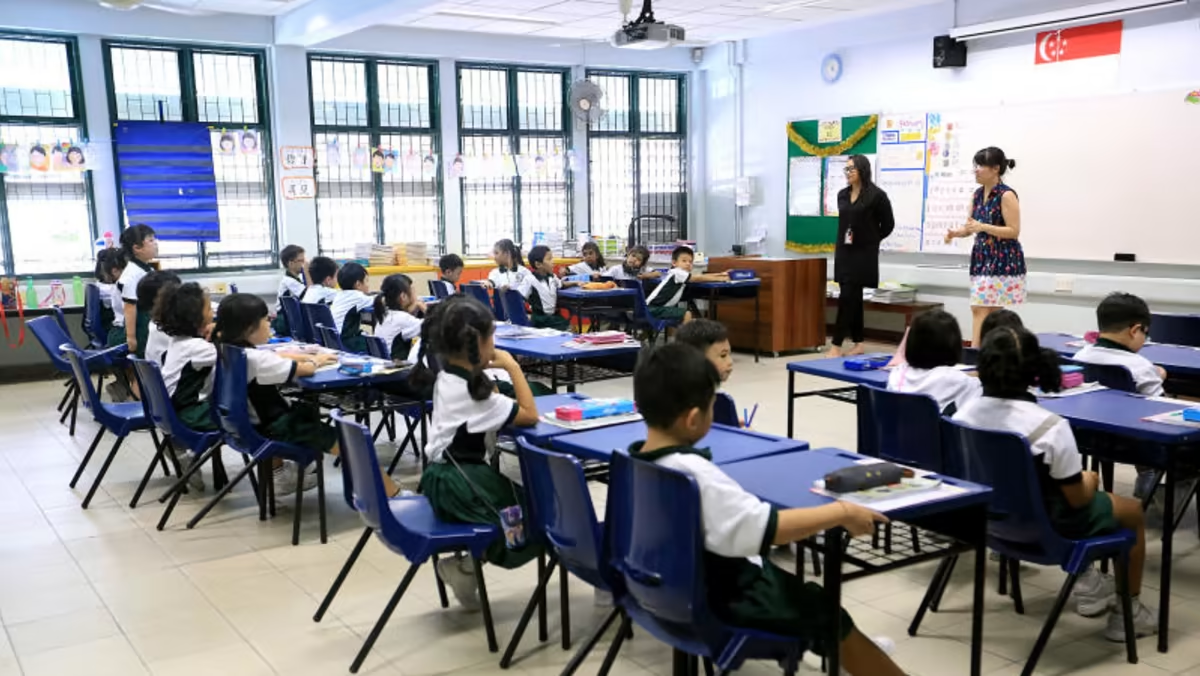
Does it really Matters to esteem clients out there?
Because home-school distance decides who gets in when a school is oversubscribed, families with the means to buy or rent near a sought-after school can improve their child’s odds — and families without that means cannot. The column also points to the waste inside the system: households incurring relocation or transaction costs, moving their whole lives closer to a school, and still balloting out. The suggestion floated was to give priority based on citizenship, and then let all local children ballot on equal footing regardless of where they live.
It’s a fair argument. Honestly, it’s the argument a lot of parents make privately after a bad ballot result. But first, the numbers compiled.
What Phase 2C actually looked like in 2026
Here’s the thing most of the commentary misses. Across all 179 primary schools, Phase 2C drew 13,102 applications for 17,193 places. Seventy-nine schools were oversubscribed, and 73 went to balloting.
Read that again. System-wide, there were roughly 4,000 more places than applicants. There is no shortage of Primary 1 places in Singapore. There is a shortage of places in about 79 of them.
That’s not a housing supply problem. It’s a preference concentration problem. And it means the “school premium” you hear about in property isn’t spread across the island — it’s clustered around a few dozen postcodes.
|
Phase 2C balloting, 2024 – 2026 Number of primary schools that had to run a Phase 2C ballot, out of 179.
In 2026 there were 13,102 applications for 17,193 places — about 4,000 more seats than applicants island-wide. Yet 79 schools were still oversubscribed and 73 balloted. Supply also fell by 776 places versus 2025, so the easing is in demand, not capacity. Longer view: Phase 2C balloting peaked at 101 schools in 2020, then 91 (2021), 90 (2022), 85 (2023), 88 (2024), 81 (2025) and 73 (2026). Sources: MOE published vacancy and balloting statuses, 2019–2026 P1 Registration Exercises. Island-wide application totals were not published in comparable form for every year and are marked n/a. |
Take the school in my client’s screenshot. MOE’s published figures for Anglo-Chinese School (Primary) showed 72 vacancies against 84 applicants in Phase 2C, with balloting for Singapore Citizen children residing outside 2km.
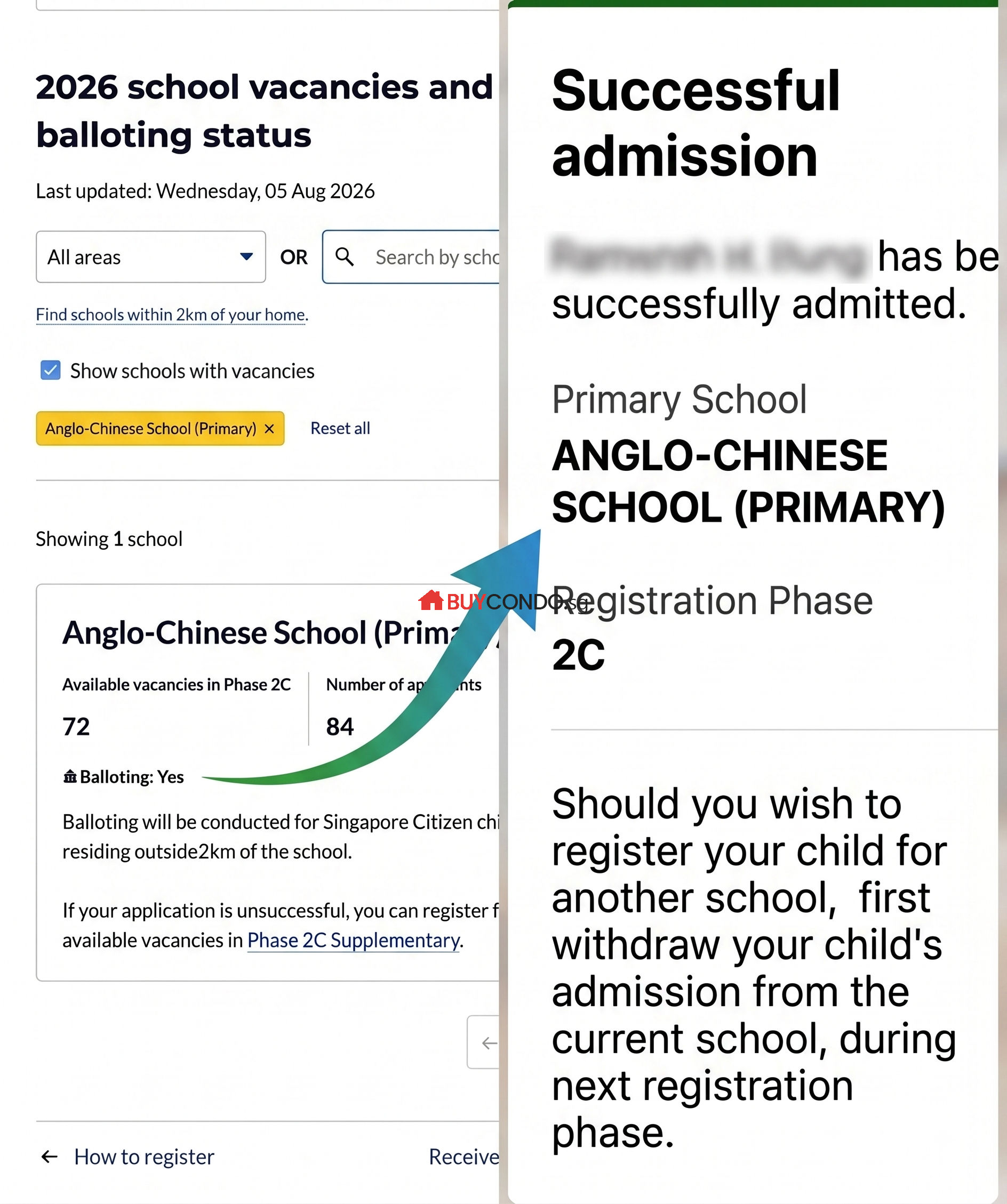
Twelve children too many. That was the entire gap. And because the ballot line fell at 2km, every Singapore Citizen child inside that radius was through. Every one outside was in a lottery.
|
The 2km line wasn’t a factor. On that day, at that school, it was the only factor. |
Earlier in the exercise, 33 schools were oversubscribed at Phase 2B and 31 went to balloting — and at a number of them, the ballot had to be run among citizens living within 1km. That is the part parents find hardest to accept: even inside the inner ring, there are schools where proximity buys you a ticket to the draw, not a seat.
Where I think the column is right
Three things, and I don’t think they’re seriously arguable.
One: it does advantage the people who can pay. Distance priority is neutral on paper and regressive in practice. A family that can shift homes has options a family locked into where they already live does not. Pretending otherwise is silly.
Two: the wastage is real. I have sat with families who moved, paid the stamp duty, absorbed the disruption — and balloted out anyway. Nobody refunds that. And the reverse case, where a family that moved for a school later finds the commute, the mortgage or the lifestyle doesn’t fit, is quieter but just as costly.
Three: it distorts the property decision itself. When a house is bought as a lottery ticket, the normal questions — is this a good home, is this a good asset, can we hold this for ten years — get pushed to the back of the queue. That’s how people end up owning something they don’t actually want.
I see the third one more than the other two, because that’s my desk.
Rejuvenation of CCR for Newton and Paterson Developments
Where I’d push back
Not on the fairness point. On what removing proximity would actually do.
Distance priority isn’t only a rationing device — it’s also a sensible one. A six-year-old living near their school walks. A six-year-old allocated across the island commutes, and somebody in that household absorbs the commute too. Pure balloting solves an equity problem by creating a logistics one, and logistics fall hardest on families without a car, a helper, or a flexible job.
There’s also a substitution risk. Remove distance, and demand for the same 79 schools doesn’t disappear — it just re-routes into whatever advantage remains. Alumni status. Parent volunteering. Church and clan connections. Those are not obviously more egalitarian than a map.
And in the background sits the demographic fact that reframes all of this: Singapore recorded 27,393 resident live births in 2025, down from 34,183 in 2021. Cohorts are shrinking — which is exactly what the falling ballot counts above are starting to show. In a decade, the pressure this policy manages may look very different, and that’s an argument for reviewing it carefully, not quickly.
My honest position: the column has correctly identified an inequity. I’m not convinced open balloting is the fix, and I’d want to see MOE’s own modelling before I cheered for it. Reasonable people land differently here, and I’d rather you form your own view than borrow mine.
But here is what I tell every client, and it has nothing to do with which side is right:
|
You have to plan for the rules that exist, not the rules that should exist. |
The 2027 intake will be decided under today’s framework. So will the 2028 one, almost certainly. If proximity is reviewed at all, it will be signposted years ahead. Buying — or not buying — on the assumption that a rule will change is speculation with your child’s schooling as the collateral.
The part nobody tells you: this is a property decision with a 30-month lock
Here’s where the school conversation becomes my conversation.
|
The 30-month stay requirement A child admitted through the Home-School Distance category must reside at the registration address for at least 30 months from the start of the P1 Registration Exercise — 30 June 2026 for this year’s exercise. For a new property, the clock starts when the family moves in. For a resale, it starts at the beginning of the child’s P1 school term. If the condition isn’t met, MOE transfers the child to a school of its own choosing — parents get no say. And if you move within that window, you’re restricted to staying inside the same distance band you qualified under. |
Sit with that for a second, because it reframes everything.
You are not buying a home for a registration week. You are committing to an address through Primary 1 and Primary 2, with a school transfer as the penalty for getting it wrong.
So the real questions are never “which condo is within 1km.” They’re:
- Can we hold this address for three years without financial strain?
- If the ballot fails, do we still want to live here?
- If our circumstances change, does this property sell or rent to someone who isn’t chasing this school?
If the answer to any of those is shaky, the proximity play is a bad trade — no matter how good the school is.
How we helped one family get there
Details generalised for privacy. No client is identified.
A couple came to me in [July/2025], renting in [Newton Area], with a child born in 2020. They opened with the question almost everyone opens with: “Which unit is within 1km?”
We didn’t look at a single listing that first meeting.
|
We started with two calendars, not one. Almost everyone merges them, and they are different things. The forward clock is the 30-month stay requirement, which begins at registration — that’s a hold commitment, and it decides affordability, not timing. The backward clock is the one that sets your real deadline: the address has to be the registering parent’s NRIC address by registration week, and a purchase, completion and NRIC update do not happen in a month. Working back from July 2026 through actual completion timelines, their decision deadline landed a good deal earlier than they’d pencilled in. Most people discover this too late. |
|
Then the map, before the money. We ran the actual addresses through MOE’s distance tool rather than trusting a project’s marketing. This matters more than people realise: within a single development, some blocks sit inside the band and others don’t, and a project marketed as “minutes from the school” can be measured into a different bracket entirely. We built a shortlist of addresses verifiably inside the band — then, and only then, filtered by budget. |
|
Then the filter that actually did the work. I asked them one question: if the ballot goes against you, will you still be glad you live here in ten years? Two properties on the shortlist died on that question. They were good tickets and mediocre homes. We cut them. |
|
Then the numbers. We ran buy-versus-rent properly — not the emotional version. Total cost of holding, stamp duty, the resale exit, what the unit rents for if life changes, whether the mortgage survives one income. Own-stay first, catchment second. That ordering is the entire method. |
|
Then plan B, before plan A was executed. We identified a second and third school inside the same distance band, and I walked them through what Phase 2C Supplementary would mean if 2C didn’t land. Nobody wants that conversation in August. Everybody wants to have had it. |
They moved. They held the address. They registered in Phase 2C.
On 11 August, they sent me the good news.
And here’s the part I want to be straight about, because agents oversell this constantly: I did not get their child into that school. The rules did, and their willingness to decide early did. My job was to make sure that if the ballot had gone the other way, they’d still be standing in a home that worked — financially, practically, for the next decade.
That’s the only version of this service that’s honest. Nobody can promise you a school place. Anyone who does is selling you something else.
If the proximity rule ever does go
I get asked this weekly now, so: what happens to prices near the top schools?
The plain answer is that some of the premium would compress. Not all of it, and probably less than people expect. The neighbourhoods that host these schools — Bukit Timah, Novena, Newton, parts of the East — carry demand for reasons that have nothing to do with Primary 1: MRT access, low-density planning, mature amenity, land scarcity. The school premium sits on top of those fundamentals; it isn’t the foundation.
Which leads to a rule I’d apply in either direction:
|
Never buy a property whose value depends on a policy staying still. |
If the only reason a unit makes sense is the 1km line, you’re not an owner — you’re a position holder with a policy risk you can’t hedge. Buy homes that stand up with the school premium stripped out. Then treat the catchment as upside.
Your next 90 days, if this is your cycle
If your child was born in 2021, you register in 2027. Your decision window is now, not next June.
- Confirm your registration year against your child’s birth date on MOE’s site.
- Shortlist three schools, not one. One is a plan. Three is a strategy.
- Verify distance by address, using MOE’s official tool — never by project name or agent claim.
- Work the 30-month clock backwards to find your true move-in deadline, and note whether new-launch or resale timing applies to you.
- Stress-test the property on its own merits — hold cost, exit liquidity, one-income scenario.
- Decide your plan B before registration week, not during it.
Run both clocks. Backward: how long a purchase, completion and NRIC address change actually take, so the address is yours by registration week. Forward: the 30-month stay requirement that starts at registration, which is what you have to be able to afford.
Steps 1–4 are free and you can do them yourself this weekend. Step 5 is provide my consult.
Frequently asked questions : 1km Advantage for Primary Schools
Does buying a home within 1km of a primary school guarantee a place?
No. Distance improves priority in an oversubscribed phase, but it does not guarantee admission. In the 2026 exercise, several schools had to ballot among Singapore Citizen children living within 1km.
What is the 30-month stay requirement?
A child admitted through the Home-School Distance category must live at the registration address for at least 30 months from the start of the P1 Registration Exercise — 30 June 2026 for the 2026 cycle. For a new property the clock starts at move-in; for a resale, at the start of the P1 school term. If it isn’t met, MOE transfers the child to a school of its own choosing.
Can I rent instead of buy to qualify?
Yes — the address on the registering parent’s NRIC is what counts, and a tenancy can be used. The same 30-month commitment applies, so a short lease taken purely for registration is precisely what the rule is designed to catch.
How many schools balloted in Phase 2C in 2026?
73 primary schools were confirmed for Phase 2C balloting in the 2026 exercise, down from 81 in 2025 and 88 in 2024.
Is it too late to move for the 2027 registration?
Not necessarily. There is no minimum period you must have lived at an address before registering — the 30-month requirement runs forward from registration, not backward. What sets your deadline is transaction reality: a purchase, completion and NRIC address update take months, and the address must be the registering parent’s NRIC address by registration week.
Will removing the proximity rule lower prices near popular schools?
Some premium would likely compress, but school proximity is rarely the foundation of value in these areas. MRT access, planning density and amenity carry most of it. No rule change has been announced.
How do I check which distance band an address falls into?
Use MOE’s official school distance query, which draws on Singapore Land Authority data. Check the specific address — within a single development, some blocks can fall into a different band than others.
If you want a hand with itI’m Gary Lim. I run buyer-side condo consultancy at buycondo.sg, and my work is own-stay purchases where the decision has real constraints attached — schools, timelines, CPF, a sale that has to close before a purchase. If you’re staring at a 2027 or 2028 registration and trying to work out whether to move, I’ll do a 30-minute own-stay and catchment planning session with you. No listings pitch. We map your dates, verify your distance bands, and pressure-test the property maths. If the answer is stay where you are, I’ll tell you that — it’s the answer about a third of the time. Send me your child’s birth year and the two or three schools you’re considering, and I’ll come back with the calendar. 老板,这不是买房。这是你下一步的棋。 |
Gary Lim · CEA Reg. No. R009877B · ERA Realty Network Pte Ltd
This article is general information, not advice on any specific transaction, and it is not affiliated with or endorsed by MOE. P1 registration rules, dates and figures are set by MOE and can change — always verify at moe.gov.sg before acting. No school placement outcome can be promised by any property professional.
Sources
- Leslie Yee, “Consider removing the property proximity advantage in allocating Primary 1 places in schools,” The Business Times, The Level Ground, 4 August 2026. Live-births graphic sourced to Singapore Department of Statistics / Immigration & Checkpoints Authority.
- MOE — How distance affects priority admission for P1 registration
- MOE — Address used for P1 registration
- MOE — 2026 Primary One Registration Exercise, 29 April 2026
- MOE — 2026 school vacancies and balloting status, last updated 5 August 2026
- Phase 2B and Phase 2C aggregate figures for 2019–2026 compiled from MOE’s published vacancy and balloting statuses for each exercise.