
New Launch Condo Discounts In Singapore: Why Developers Are Cutting Up To $1.63 Million (2026)
Table of Contents
- The story at a glance
- The Terra Hill case: $1.63m off a penthouse
- Why developers give new launch condo discounts: the ABSD clock
- The math that forces a developer’s hand
- The July 2026 rule change — and who it quietly left out
- We’ve seen this movie before: Cuscaden and friends
- How to find the next new launch condo discounts before they’re advertised
- The catch: what a discount does to the project around it
- Who should buy a discounted unit — and who shouldn’t
- How I’d negotiate one
- My verdict
- FAQ
New launch condo discounts are back in Singapore — real ones, not the “early bird” theatre you see at every launch. This month a freehold District 5 project quietly repriced almost its entire balance-unit list, with cuts running from $377,000 to $1.632 million on a single penthouse. In 17 years and 500+ transactions I’ve learned that when a developer moves prices that hard, it’s never generosity. It’s a deadline. And if you understand whose deadline it is and when it expires, you can buy very, very well — or walk into a trap that looks like a bargain.
Let me show you exactly what’s happening, why it’s happening now, and how to tell a genuine discount from a repriced mistake.
Quick Glance
| What happened | Terra Hill (270 units, freehold, Pasir Panjang) repriced nearly all 50+ unsold units in early September 2026 — cuts of $377k to $1.632m |
|---|---|
| Biggest cut | 3,035 sq ft penthouse: $8.912m ($2,936 psf) → $7.28m ($2,399 psf), roughly 18% off |
| Why now | The site (Flynn Park, bought en bloc Sep 2021 for $371m) faces its 5-year developer ABSD deadline around end-2026/early 2027 |
| Why it matters | The July 2026 ABSD timeline extension only helped large (700+ unit) sites — standard projects like this one still face the full 5-year cliff |
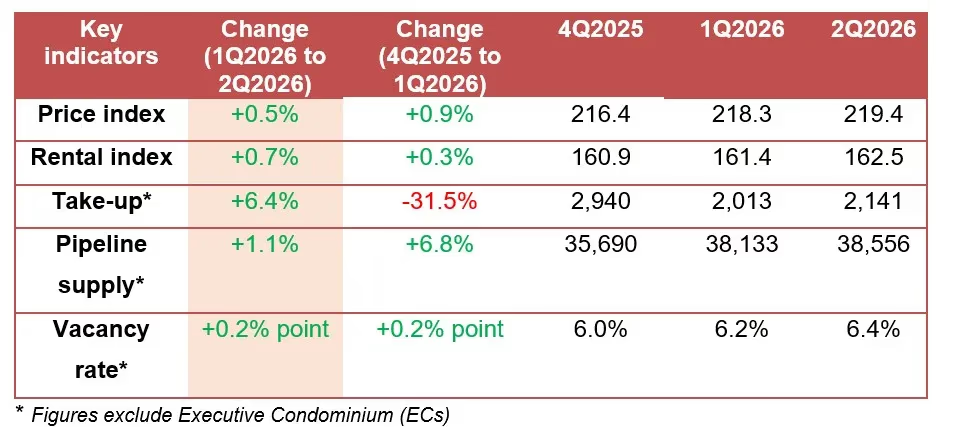
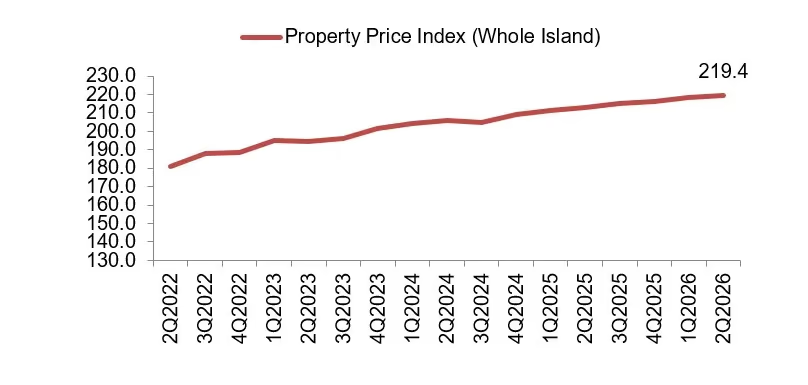
| The bigger picture | Unsold inventory sat around 15,800–16,200 units through H1 2026, with 2026 launches running ~50% above the 10-year average — more projects will reach this point |
| For buyers | Deadline-driven discounts are the best negotiating window in the new-launch market — if you check three things first (see below) |
The Terra Hill case: $1.63m off a penthouse
Terra Hill is a 270-unit freehold development on the old Flynn Park site in Pasir Panjang, about 350m from Pasir Panjang MRT, developed by a Hoi Hup–Sunway joint venture. It launched in February 2023 selling 38% on launch weekend at an average above $2,650 psf — a respectable start for a freehold hillside product, but not a sell-out. Three and a half years later, with TOP expected in early 2027, over 50 units remain — roughly 20% of the project.
Here’s what the September repricing looks like in practice:
| Unit type | Original price | New price | Cut |
|---|---|---|---|
| 3,035 sq ft penthouse | $8.912m ($2,936 psf) | $7.28m ($2,399 psf) | −$1.632m (~18%) |
| 3-bedroom (969 sq ft) | $2.517m ($2,597 psf) | $2.14m ($2,208 psf) | −$377k (~15%) |
Two details in the balance-unit list tell you the real story. First, 31 of the 50-plus unsold units are penthouses — the big-ticket, small-audience stock that always moves last in a cautious market. Second, one four-bedroom has already transacted at $3.22m, or $2,093 psf — the first Terra Hill unit to break below $2,100 psf, a new price low for the project. When the developer’s own new pricing sets the project’s floor, that’s not a promotion. That’s a clearance.
To be fair to the product: freehold, hillside, MRT within 350m, in a district with genuine long-term transformation coming from the Greater Southern Waterfront. The location thesis hasn’t changed since 2023. What changed is the calendar.
Why developers give new launch condo discounts: the ABSD clock
When a developer buys residential land in Singapore — whether a government land sale site or an en bloc — it pays Additional Buyer’s Stamp Duty of up to 40% on the land price: 5% is non-remittable (gone forever), and 35% is remittable — but only if the developer completes the project and sells every single unit within five years of acquiring the site.
Miss the deadline by one unit, and the entire 35% comes due on the full land price. Not on the unsold units — on everything. Plus 5% annual interest, backdated. There is no pro-rating, no partial credit for selling 269 out of 270. It’s the most binary tax cliff in Singapore property.
Terra Hill’s site was acquired in September 2021 for $371 million (about $1,355 psf per plot ratio). Count five years forward and you land almost exactly where we are now — the deadline falls around end-2026/early 2027, depending on when the purchase legally completed. Fifty unsold units against a clock like that explains a September repricing better than any marketing narrative.
The math that forces a developer’s hand
Let me put actual numbers on it, because once you see the math you’ll understand why these discounts are rational, not desperate — and why they tend to be genuine.
| Scenario | Rough cost to developer |
|---|---|
| Option A: miss the deadline. 35% remittable ABSD clawed back on the $371m land price | ~$130m, plus 5% p.a. interest backdated — call it $155m+ after five years of interest |
| Option B: discount every remaining unit. ~50 units at an average cut of, say, $500k | ~$25m of forgone revenue |
These are my illustrative round numbers, not the developer’s books — but the shape of the decision is exactly this. Option B costs roughly one-sixth of Option A. A developer facing this choice will cut prices every single time, and the cuts will be real, because the alternative is catastrophically worse. This is why deadline-driven discounts are the one moment in the new-launch market where the negotiating table genuinely tilts toward the buyer.
It’s also why timing matters. A developer 12 months from its deadline offers polite “star buys”. A developer 4–6 months out reprices the whole list. The closer the cliff, the better your leverage — up to the point where the best stock is gone.
The July 2026 rule change — and who it quietly left out
In late July 2026, the government extended the developer ABSD sell-out timelines for the first time: large en bloc sites of 700–1,399 units now get six years, and mega sites of 1,400+ units get seven — with a condition that mega-site developers must move at least half their units by year six or face the full clawback anyway. You can read the framework in the government’s official releases; the URA’s quarterly real estate statistics give you the supply backdrop that motivated it.
Here’s the fine print almost nobody talked about: standard sites — under 700 units — got nothing. Terra Hill, at 270 units, still faces the original five-year cliff. So do most of the 2021–2022 en bloc and GLS acquisitions now sitting in showflats around the island, because the typical Singapore condo project is a few hundred units, not fourteen hundred.
That’s why I expect Terra Hill to be the first of several, not a one-off. The 2021–2022 land-buying wave launched through 2023; five-year deadlines on that cohort cluster through 2026 and 2027. Any 2023-launched project still carrying meaningful unsold stock — and with H1 2026 unsold inventory around 16,000 units islandwide, there are several — is a candidate for the same quiet repricing in the next 12–18 months. The larger 2021-era en bloc projects (700+ units) bought themselves breathing room in July. The boutique and mid-sized ones did not.
We’ve seen this movie before: Cuscaden and friends
Deadline-driven repricing has a track record in Singapore, and it’s instructive:
| Case | What happened | Lesson |
|---|---|---|
| Cuscaden Reserve (2024) | Relaunched from ~$2,900 psf — about 20% below its earlier average transacted prices — as its deadline pressure peaked | Cuts of 15–20% are achievable when the clock is real. Buyers who waited for the relaunch beat the 2019 launch buyers by hundreds of thousands |
| Terra Hill (2026) | ~15–18% cuts across the balance list, first unit below $2,100 psf | Same pattern, new cycle |
| Lentor cluster (2025–26) | Seven launches in one precinct; sales concentrated on launch weekends, then stalled — Lentor Gardens sold 270 units on launch day and roughly nothing more that month | Where supply is thick, the leftover stock problem builds quietly even when launch headlines look strong |
| Sixteen35 Residences (2026) | Resale units trading at a record-low $1,334 psf — below what the market once paid at launch | The other side of the coin: not every “cheap” number is a developer discount; some are just markets repricing a project downward |
The Cuscaden case deserves one more sentence, because it answers the question every buyer asks me: “if I wait, will it get cheaper?” At Cuscaden Reserve, waiting paid. But the buyers who did best weren’t the ones who waited longest — they were the ones who moved in the first weeks of the repricing, when the pick of the remaining stack was still available at the new numbers. Discounts widen slowly, then the good units vanish fast.
How to find the next new launch condo discounts before they’re advertised
You don’t need insider contacts to see these coming. Three public data points do it:
Step 1: Find the land purchase date
Every en bloc and GLS award was reported in the property press with a date and price. Add five years (six for 700+ unit en bloc sites, seven for 1,400+). That’s the cliff. Projects from the 2021–2022 buying wave are the ones to watch right now.
Step 2: Check the unsold count
URA publishes developer sales monthly, including balance units per project. A project 95%+ sold will let the last units sit at full price — clawback on a fully-sold project isn’t a risk, and a developer with five unsold units can negotiate unit by unit. The discount pressure zone is projects carrying 10–30% unsold inside 12 months of the deadline. Terra Hill at ~20% unsold is the textbook profile.
Step 3: Check the unit count
Under 700 units? No extension — the original five-year rule applies, full pressure. Over 700? The developer likely has an extra year or two, and will hold pricing longer. This one filter is now the difference between a motivated seller and a patient one, and it’s the piece of the puzzle the July rule change added.
Run those three checks across the 2023 launch cohort and you’ll have a shortlist of where the next repricing lands. When you’re doing the affordability side of that homework, run your own numbers with the free calculators at listings.sg/tools — stamp duty, TDSR and loan quantum in a few minutes, before any showflat conversation.
The catch: what a discount does to the project around it
Now the honest part — the part the balance-unit flyers don’t mention.
If you bought early at full price, a repricing hurts. Terra Hill’s February 2023 buyers paid an average above $2,650 psf. The developer’s new list prices some units in the low $2,200s. On paper, a chunk of the project’s early buyers are now underwater against the developer’s own pricing — before their first day of residence. When they eventually sell, valuers and buyers will benchmark against the lowest recent transactions, including that $2,093 psf print.
If you’re buying the discount, the same mechanism works for you — mostly. You’re entering at the repriced level, so the “instant paper loss” lands on someone else. But be clear-eyed about two things. First, bank valuations for the whole project will digest these lower prints, which can affect financing on resales across the development for a while. Second, your future exit competes with a resale pool of early buyers who may need to accept losses — which can cap near-term upside even from your lower entry. A discount improves your entry price; it doesn’t repeal gravity for the project.
And check what the discount is actually on. A penthouse cut from $8.9m to $7.28m is a genuine repricing of a hard-to-sell format. It’s still a $7.28m, 3,035 sq ft purchase with penthouse-sized maintenance fees and a thin resale audience. A discount is a reason to look. It is not, by itself, a reason to buy.
Who should buy a discounted unit — and who shouldn’t
| ✅ Good fit | ❌ Poor fit |
|---|---|
| Own-stay buyers who wanted this location anyway and are getting 15%+ off a product they’d have paid full price for | Buyers who don’t actually want the location, and are being seduced by the size of the cut rather than the value of the home |
| Long-horizon owners (7–10+ years) who can ride out the project’s near-term valuation digestion | Short-horizon investors hoping to flip — you’d be exiting into a resale pool full of early buyers taking losses, and Seller’s Stamp Duty runs four years now |
| Buyers of the discounted family formats (3-bedders) where the psf reset makes the quantum genuinely competitive with resale alternatives | Buyers stretching into a discounted penthouse quantum they couldn’t have considered at full price — the discount doesn’t shrink the maintenance fees, property tax or the exit audience |
| Buyers who’ve compared against nearby resale on a price-per-usable-square-foot basis and still prefer the new product | Anyone treating “18% off” as the analysis instead of the starting point of one |
How I’d negotiate one
A few things I do for clients in exactly this situation:
Ask for the full balance-unit list, not the advertised units. Repricing rounds are rarely uniform — the developer leads with the units it most wants to move. Sometimes the better-value cut is sitting two lines down the list on a stack they haven’t advertised.
Anchor on the deadline, politely. The sales team knows their date better than you do. A buyer who is ready to transact this month — cheque, approval in principle, lawyer lined up — is worth more to a deadline-facing developer than one extra percent of price. Readiness is your leverage; use it to push on price, or on what’s thrown in.
Benchmark against the project’s own new floor. If a unit has already transacted at $2,093 psf, that print — not the old launch average — is your reference point for the stack, floor and facing you’re negotiating.
Don’t ignore the resale market next door. The correct comparison for a discounted new launch is never its own old price. It’s the best alternative your money buys today, which in most districts includes 5-to-15-year-old resale stock with bigger layouts. If the discounted unit still wins that comparison, buy with confidence. I walk through this framework in my piece on new launch vs resale condos, and the supply-side context in my Lentor oversupply take shows what happens to leftover stock when a precinct over-delivers. For the prime-district version of the unsold-stock story, my earlier breakdown of prime district condos with unsold units covers the CCR side.
My verdict – New Launch Condo Discounts In Singapore. Cross-check the project’s unsold count in URA’s monthly developer sales data.
The bottom line
Deadline-driven new launch condo discounts are the closest thing to a genuine buyer’s window in Singapore’s new-launch market — the developer’s alternative (a nine-figure ABSD clawback) is so much worse that the cuts are real, and the July 2026 rule change means sub-700-unit projects from the 2021–22 land wave get no reprieve. Terra Hill is the first big repricing of this cycle; with ~16,000 unsold units islandwide and the 2023 launch cohort’s deadlines clustering through 2027, it won’t be the last.
But a discount is an entry price, not an investment case. Buy the location and the layout at the new number — never the percentage. We Serve with Heart. 新加坡买房,就找对的团队。
Eyeing a balance unit — or holding an early purchase in a project that just repriced and wondering what it means for you? Message me and I’ll run the numbers with you, no obligation.
📱 WhatsApp Gary: +65 8986 1688
Free valuation at buycondo.sg · Market videos at buyers.sg
FAQ – New Launch Condo Discounts In Singapore: Why Developers Are Cutting Up To $1.63 Million (2026)
Why are developers giving new launch condo discounts in 2026?
Mainly the developer ABSD deadline: developers must sell 100% of a project within five years of buying the site or repay 35% ABSD on the entire land price plus interest. The 2021–2022 land-buying wave means many deadlines fall in 2026–2027, and projects still holding unsold units are repricing to clear stock before their cliff.
How big are the discounts at Terra Hill?
Reported cuts range from $377,000 on a three-bedroom (about 15%) to $1.632 million on the largest penthouse (about 18%), based on the September 2026 balance-unit repricing. Confirm current pricing directly — balance lists move weekly once a repricing starts.
Do all projects with unsold units discount eventually?
No. Projects that are nearly sold out can hold prices, and developers of 700+ unit sites now have six to seven years under the July 2026 rules. The pressure zone is standard-sized projects with 10–30% unsold inside a year of their five-year deadline.
Is a discounted new launch unit a good investment?
It’s a better entry price, not an automatic win. Bank valuations and future resales will benchmark against the lower prints, and you’ll eventually exit alongside early buyers who paid more. Judge the unit against resale alternatives at today’s prices, on a long holding horizon.
What happens to people who bought at launch when the developer cuts prices?
On paper, early buyers can be underwater against the developer’s new pricing, and project valuations take time to digest the lower transactions. If that’s you, the right response depends on your horizon — own-stayers with 8–10 years ahead usually just ride it out; would-be sellers need a realistic pricing strategy anchored to recent prints.
Can I negotiate below the advertised discount?
Often, yes — especially close to the deadline, on units outside the advertised list, or if you can transact quickly. Ask for the full balance-unit list, anchor on the project’s newest lowest psf, and make your readiness to commit part of the negotiation.
How do I find out a project’s ABSD deadline?
The site acquisition date was reported publicly when the land was bought (en bloc or GLS award). Add five years — six for 700–1,399 unit en bloc sites, seven for 1,400+. Cross-check the project’s unsold count in URA’s monthly developer sales data.
Will more projects cut prices in 2026–2027?
Very likely. Unsold inventory was around 16,000 units in H1 2026, 2026’s launch volume is running well above the 10-year average, and the 2023 launch cohort’s five-year deadlines arrive through 2027–2028. Watch mid-sized 2023 launches with double-digit-percentage unsold stock.
Disclaimer: This article represents my personal views and analysis based on information available as at September 2026, including third-party reporting on developer pricing which may change without notice. It does not constitute financial or investment advice. Figures for specific units and discounts should be verified with the developer’s appointed marketing team before any decision. Gary Lim is a licensed real estate salesperson (CEA Registration No. R009877B) with ERA Realty Network Pte Ltd (Licence No. L3002382K).